
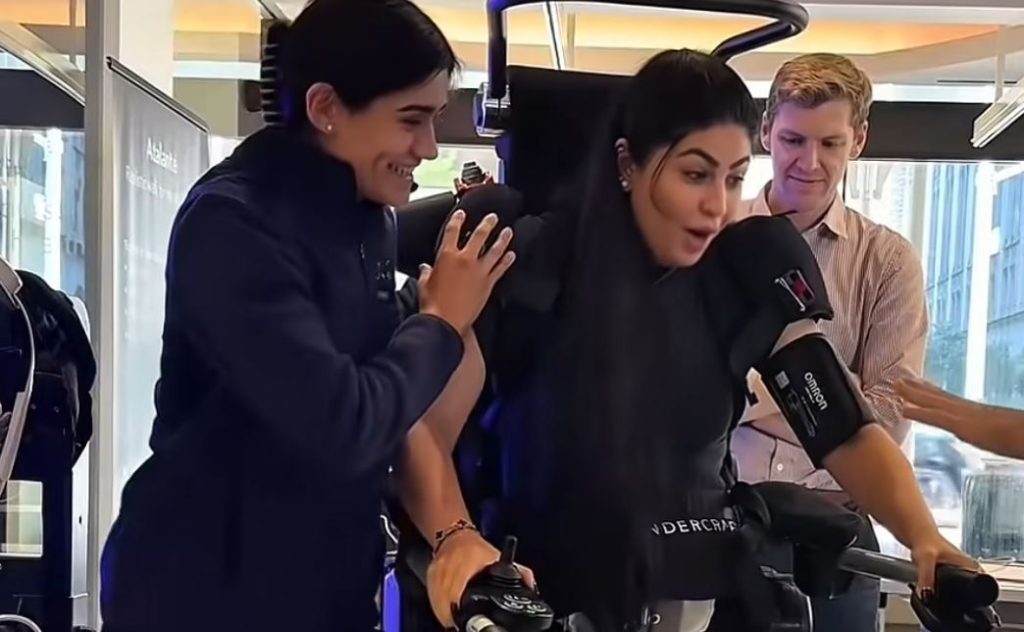
For a brief moment in the video, Jessica Tawil looks down at her own legs, then straight ahead and murmurs, “I forgot how to do this.” She’s standing straight. It has been over a decade since she did that on her own.
When Tawil suffered a T6 spinal cord injury in a car accident in 2014, she was sixteen years old and paralyzed from the waist down. At the time, she was residing in Lebanon. The wheelchair eventually stopped being a temporary solution and became an integral part of her life due to the seriousness of the accident and the length of her recuperation. She built her public persona around it, gaining over three million followers on Instagram and TikTok by showcasing the realities of everyday life for people with disabilities. Making breakfast, cooking, and navigating the world while seated. None of it was concealed by her.
Then the French robotics firm Wandercraft created the Eve exoskeleton. Without requiring the user to have voluntary muscle control beneath the injury, the wearable, motorized device supports the lower body, straightens the legs, and propels assisted steps. It is one of the few robotic assistive devices currently accessible in the US for adults with spinal cord injuries after receiving FDA clearance in August 2026. The company and Tawil are cautious about the fact that it is not a cure for paralysis, but for those who have lived without it for years, what it provides is crucial. the capacity to stand. the capacity to move forward.
When you watch the video, the technology isn’t particularly impressive. It’s the look of confusion on her face. She pauses before each assisted movement, makes small adjustments, and holds her arms slightly out. Her muscles are unable to sense what her body is recalling. “I forgot how to do this” is not a casual remark. It’s the sincere response of someone experiencing a bodily sensation they had truly stopped anticipating.
Since then, Tawil has been able to use the Eve exoskeleton at home, integrating it into everyday tasks like cooking while standing and navigating her room in a different way than a wheelchair. This integration is more important than it first appears. The physical advantages of exoskeletons, such as enhanced circulation, increased bone density, and decreased secondary complications from extended sitting, are frequently highlighted in the clinical case.
They are well-documented and genuine. However, the everyday-life aspect of using the devices is more difficult to measure and frequently holds greater significance for the users. Examples of this include being at counter height in a kitchen, standing at a social event, or just looking someone in the eye while conversing.
It’s important to put this in perspective. Rehabilitation robotic exoskeletons have been in development for about 20 years; earlier systems, such as Ekso and ReWalk, were approved by regulators in the years before. The self-balancing technology, which eliminates some of the instability that previous designs required users to manually compensate for, is what has changed more recently. Outside of a monitored clinical setting, Wandercraft’s system is intended to be more user-friendly, reliable, and intuitive. From a device that only works in a rehabilitation gym, getting to home use is a significant advancement.
Within days of its most recent online circulation, the video of Tawil standing had amassed over four million views on YouTube. People are moved by the sight of someone experiencing something they had lost, and some of the response is overtly emotional.
However, there is also a genuine discussion about access taking place beneath it between advocates for people with disabilities and those who have suffered spinal cord injuries. Eve is an expensive gadget that is still hard to come by. How soon insurance coverage or increased access to healthcare might make something like this available to those who could most benefit from it is still unknown. As of right now, only a small number of people can access it.
Tawil’s moment is still real despite this. It complicates things by providing a glimpse of what is now feasible and serving as a reminder of the gap that still exists between what technology is capable of and who can use it.
