

Anyone who has watched a sprint race knows the moment when the starting gun goes off and, by the time it’s all over, your brain hasn’t fully processed what happened. Watching Tiangong Ultra cross a 100-meter finish line is similar to that feeling, which has been present throughout human athletic history.
China’s Tiangong Ultra outperformed a few competitors at the 2026 World Humanoid Robot Games in Beijing. It beat Usain Bolt’s world record of 9.58 seconds, which had stood since 2009 and once seemed to be the limit of what any physical body could accomplish, with a final time of 8.64 seconds after running 100 meters in 8.86 seconds during its semifinal. Perhaps the most talented sprinter in human history set Bolt’s record. The Beijing Humanoid Robot Innovation Center’s 55-kilogram bipedal machine, Tiangong Ultra, just ran faster. More than once.
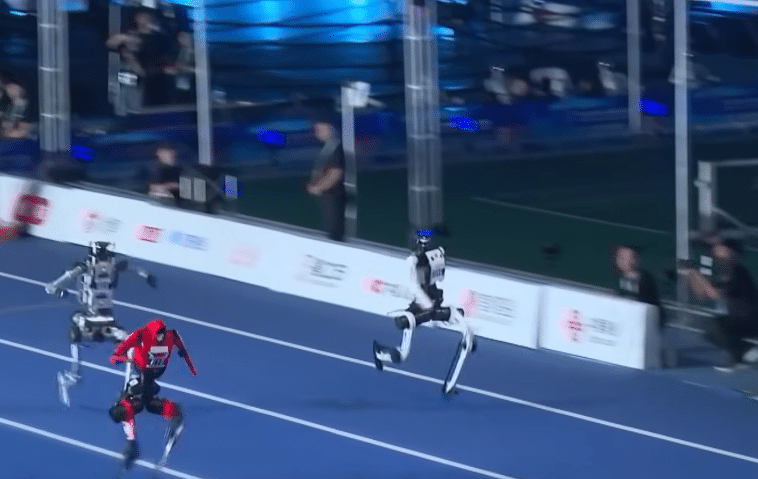
In a purpose-built environment, any single data point can be dismissed as a novelty or a controlled stunt. However, it was more difficult to ignore what transpired in Beijing during those competition days. From 9.39 seconds on opening day to 8.86 seconds in the semifinal, the robot’s times continued to decrease, with each improvement occurring within hours of the previous one. It’s not a joke. That’s a system that learns to function—or at least seems to—under duress.
Watching the sprint video reveals a detail that isn’t frequently discussed. Tiangong Ultra ran into a thick crash mat that was set up to stop the machine after crossing the finish line. The impact caused it to collapse, and a tiny fire started in its torso. There was no panic among the crowd. The cameras continued to record. A machine operating at the very edge of its capabilities, refusing to slow down even after the race was over, seemed to be the most honest moment of the entire event. It’s difficult to ignore the almost reckless aspect of that trait.
From the outside, it’s easy to underestimate the magnitude of the World Humanoid Robot Games. Football, dancing, boxing, and industrial task competitions were among the 51 events in which over 2,000 robots from 666 teams representing 16 nations participated. Not a showcase from the university. An event in a stadium. Tiangong won the same 100-meter race in the inaugural games last year, clocking in at 21.50 seconds. The 12-month improvement from 21.50 to 8.64 is the kind of figure that makes you pause in your tracks.
Beyond the sprint, four human athletic world records were broken by the Beijing Humanoid Robot Innovation Center’s Tiangong robots during the competition, including a 400-meter time of 38.15 seconds and a 1,500-meter time of 2 minutes 21.64 seconds. The majority of professional human athletes would find it difficult to match the 2.88-meter high jump result. It is still genuinely unclear whether these figures correspond to real-world capability or if they only exist under ideal competition conditions. That ambiguity is important.
The hardware of Tiangong Ultra provides some hints as to how this is made possible. Without real-time operator input, the robot navigates at speed using a combination of satellite positioning, dual lidar, and an inertial measurement unit. It is wearing specially made, shock-absorbing running shoes, which is a peculiarly human detail that is most likely intentional.
The entire high-speed system is powered by liquid cooling, and its joints are referred to as high-power integrated. It resembles the frame of a professional human sprinter at 180 cm in height and is designed for long-distance autonomous movement. The footage feels genuinely strange in part because of this similarity in scale.
In the larger robotics sector, there is a perception that a boundary was crossed in 2026—and not in a subtle way. A Fudan University graduate student was quoted as recounting the moment he witnessed Tiangong sprint past him during training—in person, not on video. He claimed that witnessing it in person had a different impact.
That’s arguably the most accurate interpretation of the significance of this moment. The figures would always sound impressive. Your understanding of the situation is altered by the physical presence of these machines, which are increasingly operating at speeds and ranges that humans are simply unable to match.
Nine units of Tiangong Ultra and similar machines have been delivered to universities and development partners, but it’s still unclear when they will be commercially available. However, the rate of advancement indicates that whatever comes next won’t have to wait long.
FAQs
1. What is Tiangong Ultra?
It’s a full-size bipedal humanoid robot developed in Beijing, China.
2. How fast did Tiangong Ultra run the 100 metres?
Its fastest recorded time was 8.64 seconds, beating Usain Bolt’s record.
3. Who built Tiangong Ultra?
The Beijing Humanoid Robot Innovation Center developed and operates it.
4. Can you buy Tiangong Ultra?
No — it’s currently available only to select universities and development partners.
5. How much did Tiangong Ultra improve from last year’s games?
It went from 21.50 seconds in 2025 to 8.64 seconds in 2026.
