

Betting on a character in a big studio movie who is speechless, lacks a human face, and spends the first act alone on a garbage-filled planet requires a certain level of bravery. That is precisely what Pixar did in 2008. And inexplicably, it performed better than nearly everything they had ever produced.
The Waste Allocation Load Lifter, Earth-Class, or WALL-E, is one of those unique inventions that has survived beyond its original decade. The idea seems almost purposefully hard to sell: after seven centuries of being abandoned on a destroyed Earth, a tiny, box-shaped trash-compacting robot falls in love with a probe robot named EVE and unintentionally saves what’s left of humanity.
The story itself, which is surprisingly straightforward, isn’t what grabs your attention when you watch it now. It’s the intensity of emotion that Pixar was able to extract from a character who primarily uses eye movements and beeping sounds to communicate.
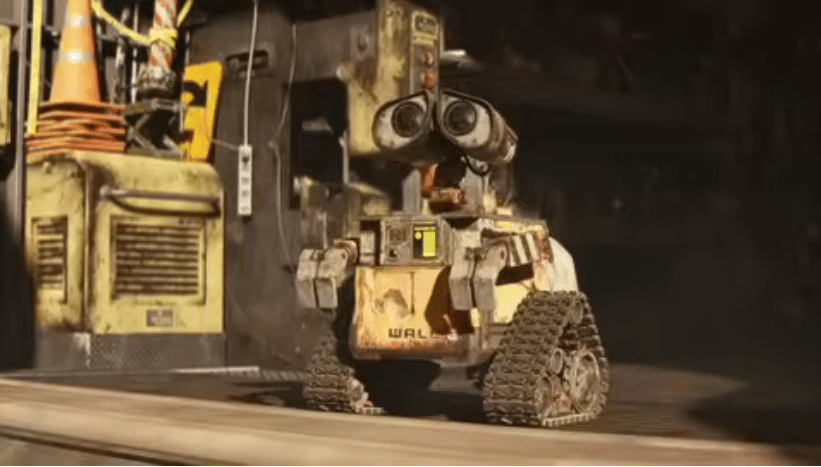
The silent film tradition of Charlie Chaplin served as a major inspiration for director Andrew Stanton, and this is evident in almost every scene in Wall-E. The robot stumbles, ponders, and becomes fixated on a Hello, Dolly VHS tape! Like a teenager who is first exposed to love poetry. It’s possible that no animated character has ever been constructed so meticulously around silence. It’s not a gimmick to have no dialog in those early scenes; it’s the entire point.
What’s intriguing—and frequently overlooked in conversations about the movie—is how seriously Pixar took the real mechanics of robot design. More than 100 degrees of freedom, or more than 100 different ways the robot could move, were reportedly counted by a Disney engineer assigned to construct a physical WALL-E replica for use at Disney World.
That character isn’t from a cartoon. That is more akin to a significant engineering issue. Roboticists who watched the movie observed that WALL-E’s treads, sensor placement, and even his solar charging system all showed real consideration for how such a machine might truly operate. It seemed that the animators had completed their homework.
Even if you’re trying not to notice it, the film’s environmental message is obvious enough. In 2805, Earth has been completely destroyed by centuries of human consumer waste, leaving only one tiny robot and one incredibly hardy cockroach. In the meantime, humans are unable to move, think, or look up from their screens as they float through space on an opulent cruise ship. The exact way that picture has aged makes me uneasy. Although it’s still unclear if Pixar meant it to be a warning or just a background, the question is more important now than it was back then.
At the 81st Academy Awards, Wall-E defeated fierce competition to win Best Animated Feature, confirming what the majority of viewers had already felt by the time the credits rolled. With well over a million votes, it currently has an 8.4 rating on IMDb, which has remained remarkably stable over time. These are not the characters from a movie that people remember with nostalgia before forgetting. These are the figures for something that actually irritated people.
Reexamining it now gives me the impression that WALL-E came at a peculiar cultural moment, just before smartphones became genuinely ubiquitous and the discussion of technology and loneliness became unavoidable. In that window, a tiny, rusty robot that was gathering trinkets and yearning for connection struck in a different way. It continues to do so. Even though there isn’t a definitive answer waiting on the other side, it’s probably worth considering whether that says more about the movie or where we’ve come from.
FAQs
Q1: What does WALL-E stand for?
It stands for Waste Allocation Load Lifter, Earth-Class.
Q2: Did WALL-E win an Academy Award?
Yes, it won Best Animated Feature at the 81st Academy Awards.
Q3: Who directed the 2008 Pixar film WALL-E?
Andrew Stanton directed it, drawing inspiration from Charlie Chaplin’s silent films.
Q4: Why does WALL-E barely speak in the film?
Pixar used silence intentionally, letting movement and emotion carry the story.
Q5: How realistic is WALL-E’s robot design?
Engineers counted over 100 degrees of movement — far beyond what’s currently buildable.
