

In the midst of the 2026 World Humanoid Robot Games, there is a moment that perfectly encapsulates everything. A humanoid robot crosses the 100-meter finish line faster than Usain Bolt ever did, arms pumping, legs churning, and briefly, almost unsettlingly, resembling an actual athlete. Then it slams into a padded wall at full speed. Sparks fly. Mechanical limbs disperse. The audience lets out a roar. And you’re not sure if you should be relieved, impressed, or a little scared of what lies ahead.
Over the course of the five days that Beijing hosted what many have begun to refer to as the Robot Olympics, there was a tension between genuine technological achievement and spectacular, almost comforting failure, as well as between awe and comedy.
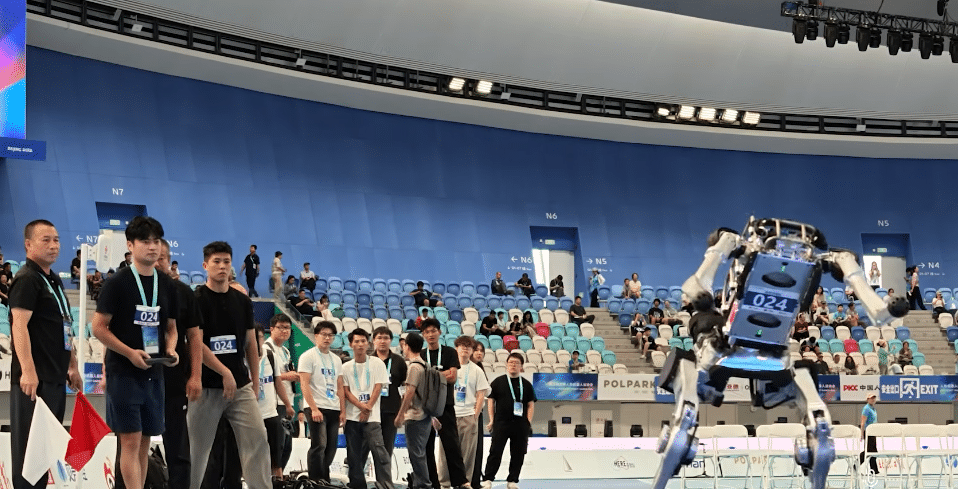
For 51 events, including the 100-meter sprint, tug-of-war, Tai Chi, breakdancing, and pitch-pot—a classic game in which you toss arrow-like sticks into a narrow-necked vase—more than 2,000 humanoids constructed by more than 660 tech companies flocked to the Chinese capital. You would be roughly right if that sounds like someone combined a science fiction book with a sports almanac.
The headline was undoubtedly the sprint records. Bolt’s renowned 9.58 seconds seemed like the kind of benchmark that would have been written off as fantasy even three years ago, but two different robots clocked faster times. Another machine easily surpassed the human world record, running 400 meters in 39.7 seconds. These figures might not make sense until you consider that the fastest robot at the previous year’s competitions required more than 20 seconds to travel 100 meters. You should be able to sit up a little straighter with that kind of improvement.
However, speed was never the main focus of the games. A parallel track of scenario-based competitions was constructed alongside the sporting event, featuring robots managing packaging, connecting cables, navigating simulated warehouses, and carrying out precise tasks in mock restaurants and offices. The contrast was intentional and, to be honest, illuminating.
Even in 2026, a machine that can outrun any human being still has trouble plugging in a cable consistently. It can run. It can jump. It’s a different, far more complex question whether it can replace a worker on a factory floor.
Naturally, it wasn’t the cable-connecting part of the video that went viral. It was the failures: a cheerleader unit flailing with its glittery pom-poms as if something had gone horribly wrong with its firmware, robots falling through obstacle courses, and occasionally martial artists landing kicks with brutal accuracy before mysteriously toppling over.
The organizers of the event seem to have a perfect understanding of this dynamic; the humor of robotic failure makes the real accomplishments more palatable, less intimidating, and, in an odd way, more human. A commentator who was watching the 400-meter obstacle race compared a struggling competitor to someone who had four bottles of wine at two in the morning. That person returned the following day to continue watching.
Even though it wasn’t always obvious, the games were also doing something more purposeful. Beijing was asserting its leadership in humanoid robotics loudly, visually, and internationally with the participation of over 660 mostly Chinese companies and extensive state media promotion. The timing of Xi Jinping’s alleged visit to Washington in the weeks after the event doesn’t seem likely to be coincidental. Whatever else it is, witnessing a Chinese-made robot break a Jamaican sprinter’s world record while the entire world watches live is a message.
American robotics firms were there, albeit less conspicuously. Experts observing from overseas characterized China’s advancements as “staggering,” a term people use when they want to be measured but are actually experiencing something more powerful. The games made it more difficult to write off the gap between Chinese and American humanoid development as being negligible, though it’s still unclear how or if it will close.
It’s more difficult to pinpoint what remains after the record tallies and highlight reels. Many onlookers who watched robots strain during weightlifting competitions reported feeling an unanticipated emotion, akin to empathy for machines that try, fail, and try again. It’s difficult to ignore what that says about us in comparison to what it says about them.
FAQs
1. Where and when were the 2026 World Humanoid Robot Games held?
Beijing, China hosted the five-day event from August 22–26, 2026.
2. Did any robot actually beat Usain Bolt’s 100-meter world record?
Yes, two separate robots ran faster than Bolt’s 9.58-second record.
3. How many robots competed in the games?
2,056 robots from 666 teams across 51 events competed.
4. Were the robots tested on anything beyond sports?
Yes, they also faced real-world tasks like cable-connecting and warehouse operations.
5. Which country dominated the 2026 Robot Olympics?
China led, with over 660 domestic companies represented among competing teams.
