

When a product is revealed in a way that isn’t anticipated, an audience experiences a certain kind of silence. That quiet moment occurred on Wednesday at Meta Connect 2026 in Menlo Park when Mark Zuckerberg produced what initially appeared to be an oversized AirPods case. It wasn’t eyewear. It wasn’t headgear. Perhaps the most surprising hardware announcement the company has made in years, it was Muse Charm, a keychain-sized portable gadget designed to run Meta’s AI agent.
Since Zuckerberg has been doing this for so long, his timing is rarely coincidental. After showing the audience the new smart glasses and the $1,299 VR glasses, which are impressive in and of themselves, he postponed the Charm reveal until later in the keynote. However, the Charm had a different vibe. Stranger, smaller, and in some way more intimate. It has a 2-inch touchscreen, 5G connectivity, and a real-time animated avatar for the Muse AI assistant. You could easily attach it to your backpack.
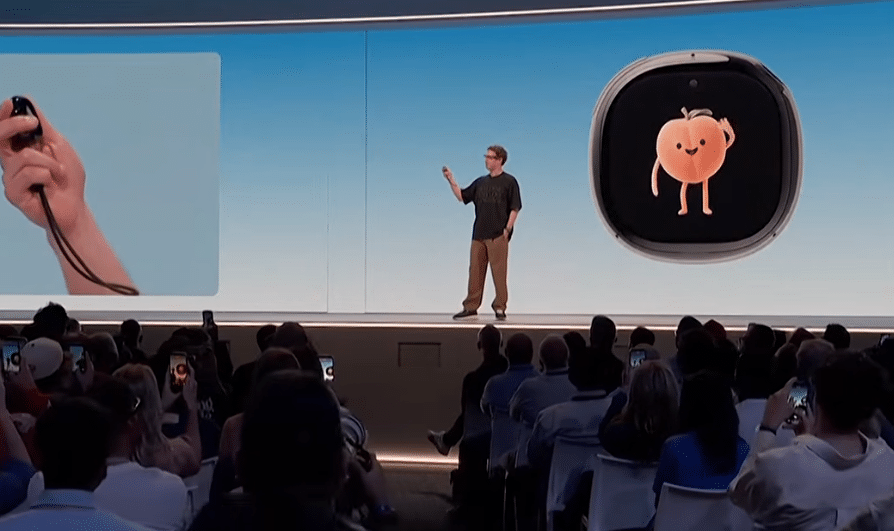
It’s difficult to ignore how nostalgic this item is. Several people on the ground likened it to a Tamagotchi, the tiny virtual pet that captured the interest of a whole generation in the late 1990s. That analogy is also most likely not coincidental. Younger people, especially Gen Z, who already view AI assistants as everyday companions rather than novelties, may actually want to carry one in physical form. This suggests that Meta has carefully considered the demographics of its most ardent Muse users.
Since its launch in early September, the Muse assistant itself has been quietly gaining traction. It has already been incorporated into Meta’s line of smart glasses, enabling voice-activated shopping, appointment scheduling, and daily tasks. The Charm expands that ecosystem to include people who just don’t want to wear anything on their faces, which turns out to be a sizable portion of the population. The Charm completely avoids this reluctance, and Meta appears to recognize that many people are still uncomfortable with wearable cameras.
Regarding where he sees this going, Zuckerberg was as forthright as usual. “In the coming years, I expect that Muse is going to grow into the personal superintelligence that billions of people are going to use,” he said on stage. The word “expect” does a lot of work in that sentence, and it’s a bold claim. It’s really unclear if Muse can reach that degree of uptake, but the infrastructure Meta is developing around it indicates this isn’t a side project. It’s the main wager.
Whether the hardware can sustain itself is the more difficult question. The market for small-screen devices and AI pendants has had a difficult few years. With great fanfare, Humane’s Ai Pin debuted and gained some traction. Rabbit’s R1 attracted inquisitive audiences but divided opinions. With significantly more resources and a pre-existing user base in the hundreds of millions, Meta is entering this market. This is a completely different proposition, but it hasn’t been validated yet. The Charm’s pricing is still unknown when it ships in December, which could be a strategic move or an indication that the numbers are still being worked out.
There was something genuinely strange about witnessing a room full of tech journalists and investors react to a gadget the size of a car fob while watching this unfold from the Menlo Park audience. The Charm might end up being a footnote, an intriguing experiment that failed. It’s also possible that after two or three years, it will become clear in hindsight, as some products consistently do after they’ve already achieved success.
There are other businesses vying for this market besides Meta. Apple, OpenAI, and a few well-funded startups are all addressing the AI-native hardware issue in different ways. For now, however, Meta has a physical product that will be shipped before the holidays, a viral assistant that is already residing in millions of eyeglass frames, and a CEO who genuinely believes he understands what will happen after the smartphone. One of the more open questions in consumer tech at the moment seems to be whether the Charm is that thing or just an intriguing step toward it.
FAQs
1. What is the Meta Muse Charm?
A keychain-sized handheld device running Meta’s Muse AI assistant with a 2-inch touchscreen.
2. When will the Muse Charm be available to buy?
Meta plans to ship it during the holiday season in December 2026.
3. Who is the Muse Charm designed for?
People who want AI assistance without wearing smart glasses or using a smartphone.
4. What connectivity does the Muse Charm support?
It runs on 5G, enabling real-time voice and avatar interactions on the go.
5. How much does the Muse Charm cost?
Meta has not announced pricing yet.
