

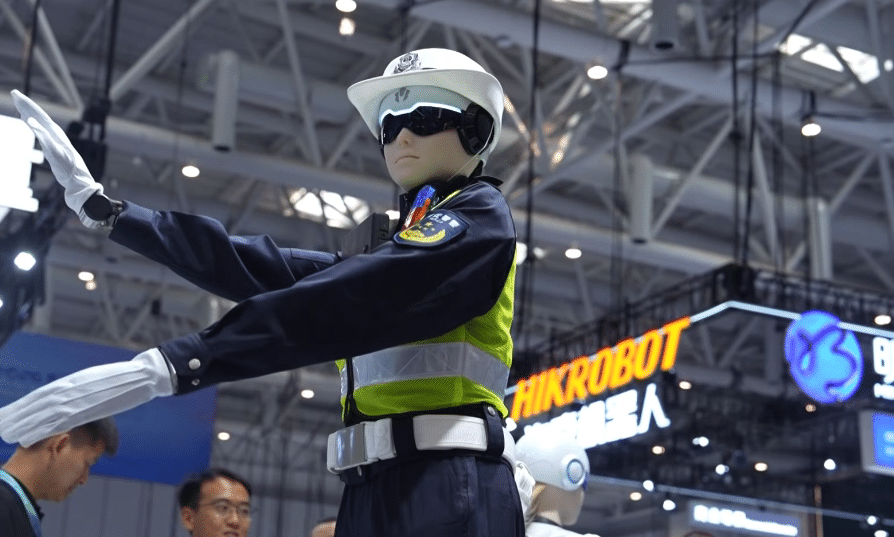
There’s a certain energy in Beijing in late August; it’s hazy, humid, and lately very noisy due to the whirring of servo motors. Held over five days at the National Convention Center, this year’s World Robot Conference was more than just a trade show. It was more akin to a show of national resolve, encased in a spectacle that was both fascinating and a little unsettling. Over three thousand items. Over three hundred businesses. Sixteen nations. And robots that seem to be able to jump two meters off the ground, dance, box, and pour drinks.
Unitree Robotics, perhaps the most well-known brand of humanoid machines in China, was the source of the headline moment. The Hangzhou-based company decided to unveil “Superman,” a robot with a two-meter standing jump and a top speed of almost 13 meters per second, on the first day of the conference. If those figures are correct, it would be faster than the majority of professional sprinters.
Although the precise purpose of that speed in the real world is still unknown, witnessing a machine launch itself into the air with such assurance alters your perception of what will happen next.
Visitors craned their phones upward to record footage of Unitree’s more reasonably priced R1 model, which starts at about 39,900 yuan, or about $5,900. Additionally, the company purposefully scheduled its stock market debut for the opening day. If you’re not considering narrative, you don’t launch an IPO the same morning your robots are dancing on stage. For the time being, investors appear to believe the narrative.
The Walker C1, a full-size humanoid that UBTECH Robotics, a Hong Kong-listed company, has been secretly creating for industrial use cases, was unveiled. Businesses like UBTECH seem to be playing a longer game, concentrating more on the contract pipeline and less on viral moments. Although it doesn’t make for very interesting videos, industrial automation usually pays well. Throughout the week, the two strategies—spectacle and substance—were on exhibit, sometimes in the same booth.
It’s difficult to ignore how much the production quality has improved. A few years ago, machines that wobbled and fell during robot demonstrations at Chinese expos required nervous engineers to hover just offstage.
This year, what was advertized as a robot mixed martial arts fight featured ENGINEAI’s humanoids trading blows. The coordination on display—the timing, the balance, and the recovery—was not the stuff of cumbersome prototypes, though it is genuinely debatable whether that is a helpful technology benchmark or astute marketing. Here, something genuine is taking place.
More than three hundred exhibitors and robots from sixteen countries attended the conference, but it would be inaccurate to claim that the international presence was on par with China’s in terms of scope or aspirations.
Clearly, this is China’s showcase. The involvement of the government is not ceremonial but structural. When Premier Li Qiang visited the exhibition in 2024, he urged the acceleration of what officials refer to as “new productive forces”—a term that combines technological urgency with economic planning. Businesses in the robotics industry are aware of the significant political impact of this industry.
A few weeks after the event ended, there is still a question regarding pace. During the week, a theatrical robot horse and rider briefly gained popularity. The humanoid bartender was impressive in a way reminiscent of a party trick.
However, significant industrial capacity is being developed somewhere between the performance and the media attention. Logistics machines, weld arms, and parcel sorters are less visually appealing but far more important. The spectacle might be partially intended to divert attention from how methodically the practical work is progressing.
In one version of the story, all of this continues to be primarily a domestic Chinese development for an additional ten years. In a different version, these machines become globally inevitable much sooner than most Western competitors would like due to supply chains, pricing, and manufacturing scale. That question remained unanswered at the 2026 World Robot Conference. However, it clearly did sharpen it.
FAQs
1. Where and when was the 2026 World Robot Conference held?
It ran August 19–23 in Beijing, China.
2. How many products were showcased at the event?
Over 3,000 products from more than 300 exhibitors across 16 countries.
3. What was Unitree Robotics’ most talked-about reveal?
A robot called “Superman” capable of a two-metre standing jump.
4. What is the starting price of Unitree’s R1 humanoid robot?
Approximately $5,900, or 39,900 yuan.
5. Who co-hosts the World Robot Conference?
The Chinese Institute of Electronics and the World Robot Cooperation Organization.
