

The broadcast footage from Beijing’s National Speed Skating Oval stops you cold at one point early on. At a starting block, a row of humanoid robots crouches. There’s a horn. One of them, a machine made by the phone company Honor, crosses a finish line in 9.32 seconds. They lurch forward, metal legs swinging with that unsettling combination of mechanical precision and barely-contained chaos. Since 2009, Usain Bolt has held the world record. This robot was more than just a match. It destroyed it.
August 21st was that date. Officially, the second World Humanoid Robot Games had started. What transpired over the course of five days was truly hard to describe.
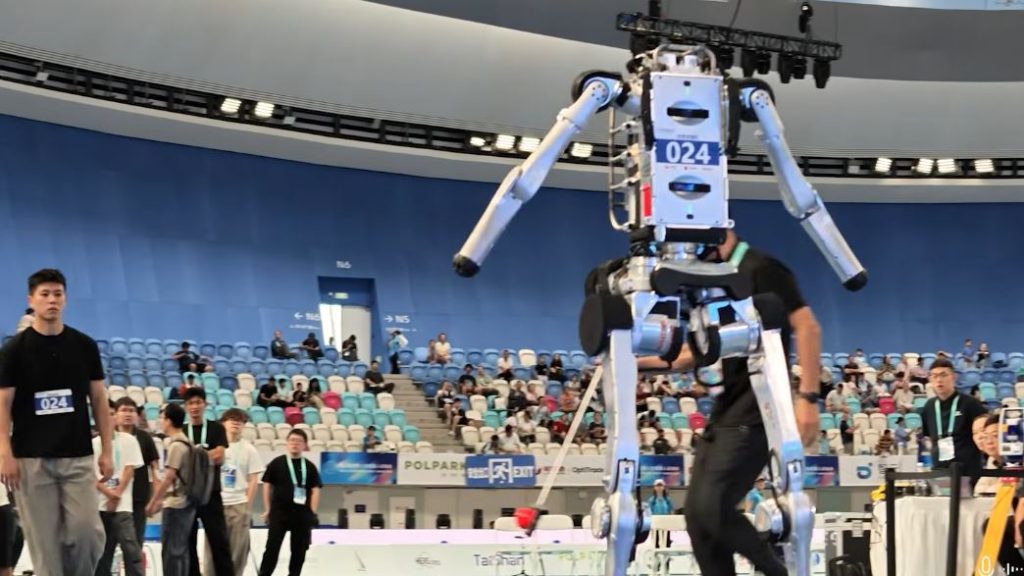
The games, which included over 2,000 robots from 666 mostly domestic Chinese tech companies competing in 51 events ranging from the 100-meter sprint to boxing, breakdancing, obstacle courses, and weightlifting, were a combination of sporting spectacle, state propaganda exercise, and investor road show. Globally, millions of people watched livestreams. Videos went viral. As robots fell, exploded, and occasionally showed glimpses of something that felt almost unsettlingly capable, commentary alternated between sincere amazement and schadenfreude.
There were plenty of blooper reels, and it’s simple to watch them and feel reassured. During the sprint, one robot’s pelvis literally burst. Some were unable to climb a flight of stairs without making faces that would make a slapstick director proud. Charlie Higson, a comedian, likened the obstacle course to the Upper Class Twit of the Year sketch from Monty Python. That response makes sense. I also think it’s a little risky.
Because entertainment was never the main purpose of the event. The Mercator Institute for Chinese Studies estimates that in 2025, China produced about 12,800 humanoid robots, or roughly 90% of the global total. American technology strategists should be concerned just by that figure. In addition to entertaining a worldwide audience, the games were intended to put pressure on a domestic industry that Beijing is purposefully fostering.
Engineers from competing firms were in sync, observing each other’s mistakes and picking up lessons in real time. China even started a formal initiative in 2024 to promote data sharing among humanoid startups. Cooperation and competition at the same time.
When Western observers watch such events, it seems like they are constantly aiming for the incorrect frame. The games were largely portrayed in English-language media as a spectacle or a propaganda stunt, which was undoubtedly partially true. However, Chinese state media coverage presented a different picture, emphasizing what those robots might eventually do, such as work on factory floors, navigate warehouses, and help in homes, rather than the spectacle of robots competing in races. The main focus was on the practical vision. The message was not conveyed through the athletic events, but rather through the wrapper.
Timing is also important. The games concluded just a few weeks before Xi Jinping and Donald Trump are scheduled to meet in Washington, where technology competition will be a major topic of discussion. Before a single competitor crossed the finish line in Beijing, Trump’s administration had already outlawed the import of Chinese humanoids and four-legged robot dogs. According to reports, Elon Musk’s long-promised Optimus humanoid is just now entering production. In ways that merit greater attention than they currently receive, the gaps between promise and delivery on the US side and between spectacle and output on the Chinese side are closing.
Whether China’s superior humanoid volume translates into superior capability is still up for debate. Robots that are arguably more advanced in certain applications are being developed by several American and European companies. However, the supply chain infrastructure China has established—the kind that allows a smartphone company like Honor to pivot into record-breaking humanoid robots without apparent strain—is not something the US can quickly replicate. Volume has a quality all its own.
Investors in Silicon Valley seem to have noticed: this autumn, reports surfaced of American investors surreptitiously visiting Chinese robot factories, attempting to comprehend what they’re seeing before determining how to react.
As all of this is happening, it seems like the US is still viewing humanoid robotics as a future technological issue that will be resolved when the market is more developed. By seeding hundreds of businesses, establishing strict public deadlines through events like these games, and clearly connecting the entire endeavor to national strategy in everything from labor markets to military applications, China is approaching it as a present.
Seeing robots compete in sports is one thing, according to a senior Indian police official who was watching the coverage. It will be quite different to see them on borders one day, armed and capable of making choices. It’s not a paranoid idea. It’s a logical extension of a trajectory that is obviously already moving.
FAQs
Q1. What are the World Humanoid Robot Games?
An annual Beijing competition where thousands of robots race, box, and perform industrial tasks.
Q2. How fast did China’s robots run the 100-meter sprint?
Honor’s Lightning ran it in 9.32 seconds, beating Usain Bolt’s human world record.
Q3. Why is China investing so heavily in humanoid robotics?
To address labour shortages, expand military capability, and dominate a critical emerging industry.
Q4. How far behind is the US in humanoid robot production?
China produced roughly 90% of the world’s humanoid robots in 2025 alone.
Q5. Should the US be concerned about China’s robotics progress?
Yes — China’s scale, supply chain, and national strategy give it a significant structural advantage.
