

There is a specific type of video that unexpectedly destroys the internet. No scandal, no celebrity—just a humanoid robot running faster than the fastest human in history before crashing headlong into a padded wall in a blast of flames, sparks, and strewn mechanical limbs. That ten-second video probably raised more awareness of China’s robotics sector worldwide than any white paper or trade show could. Welcome to the World Humanoid Robot Games 2026, which took place in Beijing over five amazing, confusing, and sometimes terrifying days in August of last year.
More than 2,000 robots from more than 660 teams competing across 16 countries attended the event, which was officially its second edition but felt like nothing the world had seen before. Just the scale was astounding. However, the experience of witnessing a cheerleader bot swing glittery pom-poms in what can only be described as a mechanical seizure, or a humanoid trudging through the 400-meter obstacle course with the energy of someone who had, as one social media comment put it, consumed four bottles of wine at two in the morning, is not adequately captured by numbers. The captions came from the internet. The robots came from China.
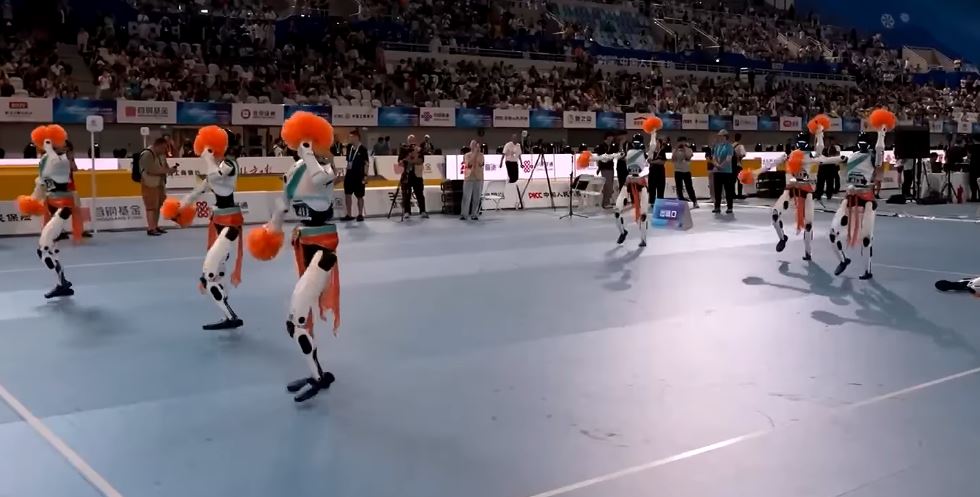
The peculiar dual nature of the entire spectacle is difficult to ignore. On the one hand, this was a real propaganda ploy, a planned demonstration of technological prowess timed in proximity to Xi Jinping and Donald Trump’s planned summit in Washington. Approximately 12,800 humanoids, or 90% of the world’s total, were produced in China last year. The games served as a live billboard for international consumers who were still debating whether to buy Chinese-made devices at a time when Trump had recently prohibited their import due to national security concerns. Quietly, the stakes were very high.
However, nobody was able to fully appreciate how hilarious everything was. Beijing provided both comedy and state-of-the-art engineering at the same time, which is uncommon. Robots that just fell for no apparent reason shared airtime with Android martial artists who delivered knockout roundhouse kicks. On the football field, a humanoid performed Cristiano Ronaldo’s famous “Siuuu” celebration. Captains on enormous mechanical dogs waved flags as robot teams marched into the opening ceremony. After comparing the obstacle course scramble to Monty Python’s Upper Class Twit of the Year sketch, comedian Charlie Higson returned the next day because, in his words, “they get better and better.”
Some observers were taken aback by China’s seeming ease in publicizing its own shortcomings. Alongside the victories, official competition footage of exploding pelvises went viral. This transparency seems to have been intentional in and of itself, sending a subliminal message that China’s robot industry was developed enough to withstand public humiliation while continuing to innovate. That is a specific type of assurance. It’s still unclear if it’s totally justified.
Genuine emotion was the outcome of the weightlifting event, which no one had anticipated. Tensing as the machine strained upward, viewers became invested in whether a robot could lift a loaded barbell. One comment said, “Way more emotional than I expected,” and it spoke for millions. Perhaps the most illuminating thing the games showed was how easily humans project emotion onto machines that lack it, rather than raw speed or mechanical accuracy. It will probably take years to fully comprehend the significance of that dynamic as it unfolded at scale in front of a worldwide audience.
Foreign military observers were less amused. It was entertaining to watch robots run, box, and play football, according to a senior Indian police officer, until you imagined them carrying weapons at a disputed border. That was a lingering thought. At the same time that the Beijing Games were coming to an end, Ukraine was holding a military demonstration in Kyiv that featured only robotic weapons. No one who was paying attention missed the timing.
The viral videos will stop. They most likely won’t represent the underlying trajectory. China’s robot industry is expanding quickly—possibly faster than most Western analysts predicted even three years ago. Although US competitors are reportedly accelerating and Elon Musk’s Optimus is finally going into production, there is still a significant volume and variety gap. Beijing’s games were hilarious, wild, and truly amazing. Depending on how you interpreted the space, they were also a sneak peek at something much bigger.
FAQs
Q1. How many robots competed at the Beijing Humanoid Robot Games 2026?
Over 2,000 humanoid robots from 660+ teams across 16 countries competed.
Q2. What was the most talked-about moment from the games?
A robot ran the 100m faster than Usain Bolt, then crashed spectacularly.
Q3. Why did China host such a large-scale robot competition?
It was a strategic showcase of technological dominance timed before a US-China summit.
Q4. Did the games feature only serious athletic events?
No — breakdancing, cheerleading, and Tai Chi were among the more surprising events.
Q5. What concerned international observers watching the games?
The robots’ combat capabilities raised fears about future military applications at contested borders.
