
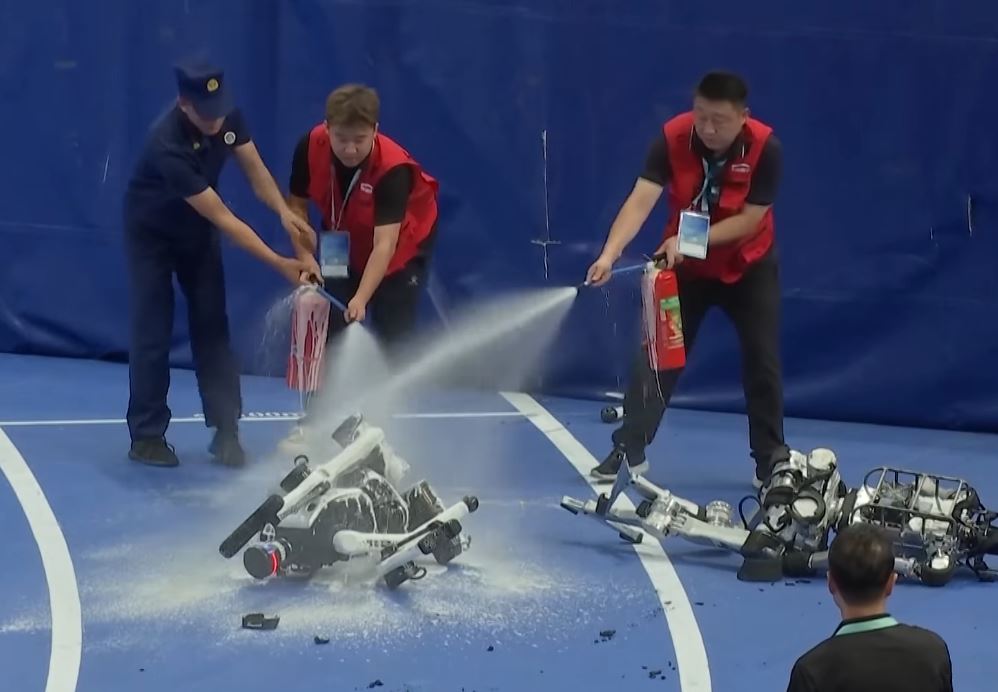
Last Tuesday, during the 100-meter final at Beijing’s National Speed Skating Oval, a white, headless humanoid robot named Tiangong Ultra crossed the finish line at a speed that no human has ever matched—8.64 seconds flat. However, because no one had apparently programmed it to stop, it continued running straight into a padded barrier. Fire extinguishers were rushed in by officials. By most accounts, the audience went insane.
The World Humanoid Robot Games were held here. If you are unfamiliar with it, it appears to be a mistake that should be fixed.
Over 2,000 robots from 666 teams from sixteen countries participated in the five-day event, which took place from August 22 to August 26. They were all gathered in the same location where Olympic speed skaters used to glide in near silence. The contrast seemed almost purposefully dramatic. These machines were sometimes designed to run quickly in a straight line, whereas those athletes had trained for years to cut seconds off their times. That’s all. Apparently, it was up to them whether or not they stopped afterward.
And that’s what keeps bothering me. With a 9.39-second run earlier in the week, an 8.86 in qualifying, and an incredible 8.64 final, Tiangong Ultra destroyed Usain Bolt’s 9.58-second world record. That is almost a full second quicker than the fastest person ever measured. That is an outstanding engineering accomplishment by any standard. However, you then view the video. You watch as the robot crosses the finish line at full speed, makes no effort to slow down, and collides head-on with a cushioned wall. Sparks and fire. extinguishers. It’s equally amazing and ridiculous.
To put it simply, Dipam Patel, a Purdue University PhD candidate in computer science who specializes in robotics, stated that the objective was to cross the line. There was never any consideration of stopping. While officials scrambled nearby, a number of robots not only failed to stop, but they also broke apart at the waist, spraying sparks onto the track. One machine caught fire in an almost ceremonial manner, its legs still pumping feebly as a foam nozzle was aimed at it by a person wearing a high-visibility vest.
It’s difficult to ignore how well this depicted the contradictory aspects of what China is attempting to present to the world. At a time when China’s robotics industry is growing faster than most Western analysts predicted, the government and state media were obviously invested in the spectacle. And the message landed on the sprint track. These are not the shuffling, awkward humanoid prototypes from five years ago. It takes truly sophisticated whole-body control—arms, hips, legs, and balance—to move that quickly.
Then there were the laundry chores. Robots were tasked with washing and hanging clothes in a more subdued area of the arena. They took their time moving. methodically. At best, human-paced; in certain situations, much worse. It appears that there is a significant difference between what these machines can accomplish when designed for a single, lightning-fast sprint and what they can accomplish when asked to mimic the mild, repetitive complexity of daily life. It is both amazing and bizarre that a robot can run 100 meters in 8.64 seconds while hanging a shirt takes twelve minutes.
One machine from X-Humanoid, a Beijing-based company, went viral for something completely different: it won the 400-meter small-group race while holding its arms up close to its face in a position that onlookers repeatedly described as a “shy person hiding behind their hands”. That strange arm position turned out not to be a malfunction. The robot essentially discovered on its own that this posture, along with hip rotations, yielded better results than the typical runner’s arm swing after being trained through reinforcement learning in simulation. It appeared strange. It was successful.
The idea of a machine creating its own running style through trial and error and coming up with a solution that no human coach would ever recommend has an unexpectedly poetic quality. It depends on who you ask whether that qualifies as creativity or just optimization, and to be honest, it’s still unclear if the distinction matters.
Even though these games were chaotic and intense, it seems obvious that they represent something genuine. In the first event last year, robots were unable to match human records. Four of them are being broken this year: the high jump, 100, 400, and 1,500 meters. That trajectory is quite steep. According to Patel, the results would be more significant if robots were trained to run the same race ten times, demonstrating dependability as opposed to a single peak performance. It’s a valid point. A proof of concept is a machine that runs for 8.64 seconds once and then catches fire. Something completely different is a machine that runs for 8.64 seconds ten times and stops cleanly each time.
For the time being, Beijing offered the world a glimpse of both possibilities—the burning and the record-breaking—sometimes within seconds of one another. It was one of the strangest sporting events in recent memory by any measure. And for some reason, it seemed like only the beginning.
FAQs
1. What record did Tiangong Ultra set at the Beijing Robot Games?
It completed the 100-meter sprint in 8.64 seconds, beating Usain Bolt’s record.
2. Why did robots catch fire at the event?
They couldn’t decelerate after the finish line and crashed into barriers at full speed.
3. How many robots competed at the 2026 World Humanoid Robot Games?
2,056 robots from 666 teams across 16 countries participated.
4. Did the robots perform well in everyday tasks like laundry?
No — they moved significantly slower than humans in practical household challenges.
5. What made the X-Humanoid robot’s 400-meter win unusual?
It won using a self-learned “hands-near-face” posture no human coach would suggest.
