
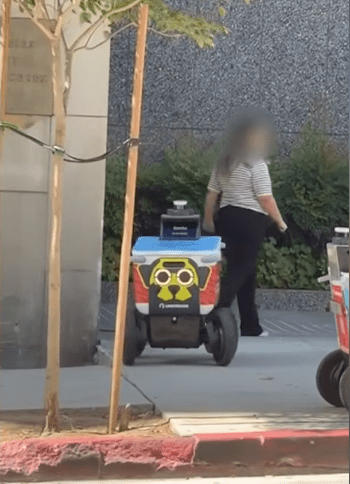
What transpired on a Los Angeles sidewalk earlier this month was precisely the kind of moment that the internet is designed to magnify: something small, a little ridiculous, and unexpectedly human. A woman saw a sidewalk delivery robot wedged into a bush while traveling. She didn’t pass by. She came to a stop, worked at its wheels, pushed it back onto the sidewalk, and pointed it in the direction of the street. After two blinks, the robot resumed its journey. She carried on with her day.
It was captured on camera by KTLA’s Peter Wilgoren. He gave it to others. After that, it was present everywhere.
To be honest, the responses that followed were more fascinating than the actual rescue. It wasn’t because of what people said about the woman—the majority thought she was decent for stopping—but rather because of what they said about the robot. Some people thought it was too adorable, likening it to an overgrown Roomba. Others were quietly incensed, pointing out the blatant irony that a human volunteer had volunteered to fix a machine that had replaced a human worker. One commenter simply wrote, “push that thing down the stairs,” with the kind of succinctness that cuts right through everything. It is impossible for anyone who reads that to claim they are unaware of the frustration it causes.
What went viral might not have been a robot rescue at all. On a sidewalk in downtown Los Angeles, the question was posed in real time: What precisely is our relationship with these machines supposed to look like? The woman was helpful. At least one commenter claimed that those in her immediate vicinity merely observed. Juan Manuel also noted this, noting that she completed the task on her own and that she was a valuable neighbor. The human watching the human assist the robot while other humans did nothing received less attention than that portion of the narrative. It most likely ought to have.
Currently, Serve Robotics operates over 500 of these bots in 40 neighborhoods in Los Angeles. It’s so prevalent that for people living in many parts of the city, seeing one has become more of a habit than a novelty. Although the company’s 99.8% completion rate is impressive on paper, it also quietly acknowledges that the 0.2% does occur. Sometimes it takes place in front of a camera, in a bush, or on a sidewalk in the downtown area.
A point made by Dr. Chris Mattmann, a professional in this field, stuck with me. He claimed that humans have empathy and the capacity to see a small, struggling machine as something worth aiding rather than something to ignore or kick, which robots just don’t have. He claims that when he advises people to treat their printer with kindness, he is only half-joking. Beneath the humor is a serious disagreement. Only a small number of early robots are currently in use in Los Angeles. They only have a few easy tasks to complete. It may be more important than it first appears how people treat them now, whether they support them, ignore them, or harbor resentment.
However, it’s still unclear if compassion for a cute sidewalk robot translates into anything more. It wasn’t inappropriate to be angry in those remarks. In one way or another, these machines do compete with the people who used to earn money making the same deliveries. You may feel warm when you see a woman entice one from the bushes and send it back on its way. Alternatively, you may experience a more complex feeling. They both seem reasonable.
The image itself is more difficult to dispute. A person, by herself, mending a malfunctioning object as the city passed by. Regardless of your opinion of the robots or the businesses that manufacture them, there is a familiar feeling in that instant: the desire to assist a small object that is stuck. Whether or not the little thing is employed.
There is no end in sight for the delivery robots. More than most places, Los Angeles has come to terms with that. The autonomous vehicles, sidewalk robots, and camera-equipped vehicles that move through neighborhoods at all hours have all become a part of the urban landscape. It’s more difficult to read how locals truly feel about that behind the viral videos and comment sections. As of right now, at least one woman has expressed her opinions.
FAQs
1. Who rescued the delivery robot in Los Angeles?
A Los Angeles Hall of Records employee freed it from sidewalk bushes.
2. Which company owns the delivery robots rolling through L.A. neighborhoods?
Serve Robotics operates the fleet across 40 Los Angeles neighborhoods.
3. How many delivery robots does Serve Robotics currently have in Los Angeles?
Over 500 robots are actively deployed across the city.
4. What happens when one of these robots gets stuck or breaks down?
A remote monitoring team dispatches a local field crew to assist.
5. Why did the rescue video spread so widely across social media?
It sparked genuine debate about human empathy, robot labor, and coexistence.
