

There is a moment on the Beijing 2026 World Robot Conference exhibition floor where the crowd simply stops. This moment is captured in a number of amateur videos that are currently making the rounds. Not the practiced, courteous attention you get at trade exhibits. A real, a little taken-aback pause. Because what they are witnessing is a humanoid robot sitting upright and moving across the floor in slow, somewhat awkward steps while mounted on a four-legged mechanical horse. As a visual, it shouldn’t function. And yet it does, in some way, entirely.
Built by DaxAI Robotics, a Beijing-based company that hardly existed two years ago, the machine performing the carrying is known as the Qiji X1. The machine’s design reflects Wang Kun’s background in robotics and autonomous driving. handlebars in front, a saddle in the middle, and four movable mechanical legs. China’s Tien Kung 3.0 humanoid, a robot designed for high-dynamic whole-body control, was the rider in Beijing demonstrations. They make an odd couple. One machine supports another, each providing something that the other cannot handle on its own.
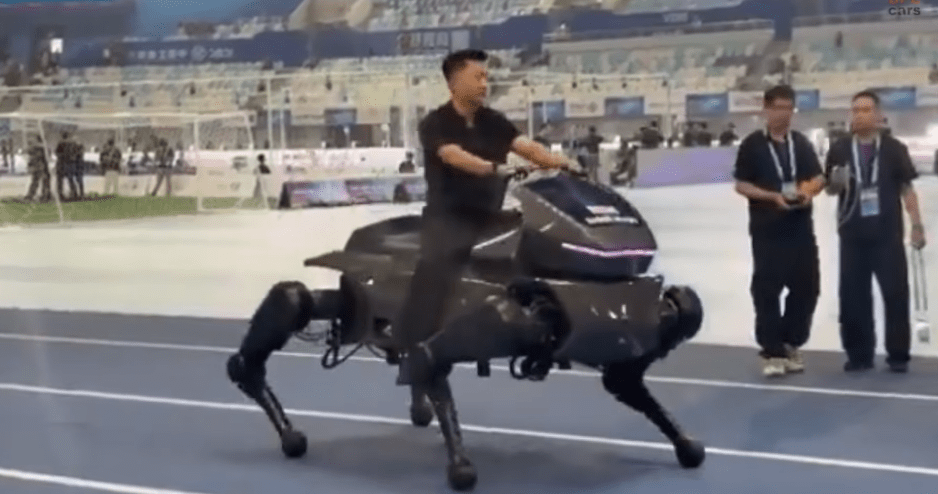
Although it is difficult to ignore, the Qiji X1’s spectacle isn’t what makes it truly fascinating. It’s the fundamental reasoning. Wang’s team has made it clear why the combined system is important: the humanoid focuses on accuracy once it is positioned, while the mechanical horse manages load and terrain, moving across surfaces where wheels would fail. For example, a wheeled robot simply cannot get to the necessary location in mountain rescue situations. A legged carrier that delivers a skilled robot to the location is a completely different idea.
It’s worth stopping to look at the numbers. A 660-pound dynamic payload. A 40-kilometer range between charges. travels at a speed of six to ten kilometers per hour. Naturally, none of this is supercar performance, but it was never intended to be. The Qiji X1 promises to provide sturdy, dependable, load-bearing mobility over uneven terrain, and early tests seem to show that it does.
Beijing was the first real test. The Tien Kung 3.0 was put atop a mechanical horse and given the task of horseback archery back in July at a racecourse close to Sayram Lake in Xinjiang, which is located at an elevation of more than 2,000 meters. To be sure, it’s an odd benchmark. However, the decision was well thought out. Because labs are unable to replicate them, X-Humanoid, the Beijing organization behind the relay series that organized the event, has been pushing robots into truly unstructured outdoor environments. Even though it may seem dramatic, a test with high altitude, erratic terrain, a moving platform, and a precision task at the end is meaningful.
The archery demonstration might have been more performance than evidence. Not everyone in the robotics community is quick to accept demonstrations at face value, and China has a history of putting on robotics showcases that combine real capability with expertly staged impressiveness. However, there is a difference between questioning a showcase’s polish and questioning the underlying engineering, and the Qiji X1’s specifications indicate that significant effort has gone into the latter.
Here, the larger context is important. Over 2,000 robots from 16 countries participated in the 2026 World Robot Conference, which coincided with the second World Humanoid Robot Games. One of the biggest humanoid manufacturers in the world, Unitree Robotics, debuted on the Shanghai Stock Exchange on the first day of the conference. China is not conducting covert robotics experiments. It is making large, loud, and public investments in it, treating the sector similarly to how it handled electric cars ten years ago.
As all of this develops, it’s difficult to avoid thinking that the Qiji X1 is a bit ahead of what the general public currently believes. The slick bipedal machines performing backflips in Boston Dynamics videos are what most people imagine when they think of sophisticated robots. A carrier with four legs and a saddle seems to prioritize novelty over technology. Perhaps that instinct needs to be revised. In ways that a single multipurpose robot frequently isn’t, the architecture—a mobile platform that delivers a precision operator to an otherwise inaccessible site—is truly practical.
It’s still unclear if the Qiji X1 will be used outside of exhibitions. There is a significant gap between conference demonstration and operational use, and there are many engineering issues that make for poor photography. However, DaxAI Robotics has at least persuasively argued that the question is worthwhile. A robot on top of another robot. It sounds like a joke. It could prove to be more than that.
FAQs
1. What is the Qiji X1?
It’s a rideable four-legged robot built by Beijing-based DaxAI Robotics.
2. How much weight can the Qiji X1 carry?
It handles a dynamic payload of up to 660 pounds (300 kg).
3. Where was the Qiji X1 first publicly demonstrated?
At a racecourse near Sayram Lake, Xinjiang, in July 2026.
4. What humanoid robot rode the mechanical horse?
China’s Tien Kung 3.0, designed for high-dynamic whole-body control.
5. What real-world uses are planned for this system?
Mountain rescue, disaster response, and patrols across terrain vehicles can’t reach.
