
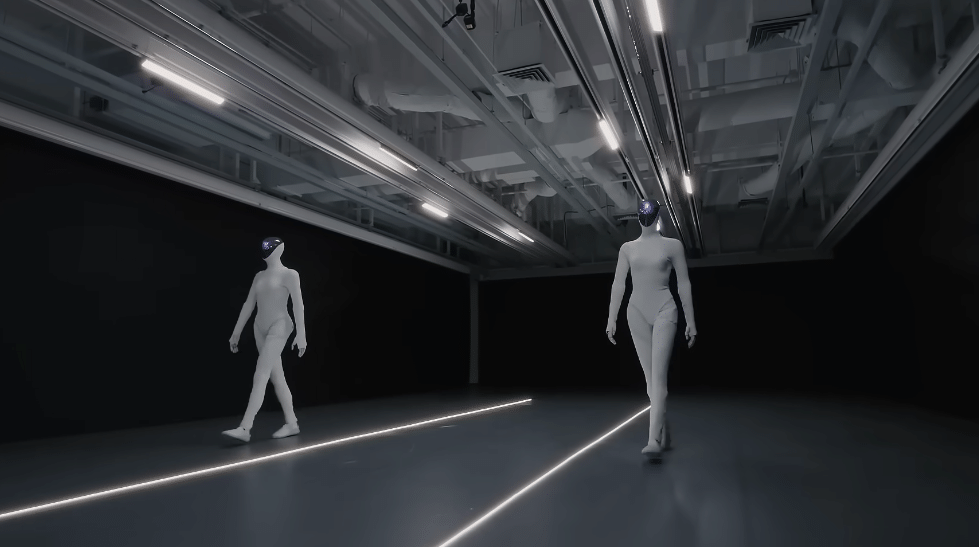
Observing a humanoid robot leave its own manufacturing line is almost disorienting. We’ve been hearing about this technology for years, so it’s not that it’s impossible; rather, it happened on September 8, 2026, at a Guangzhou factory. There is no stage of demonstration. No meticulously planned press conference. Just IRON, an upright and moving robot, moving away from the line that had just completed its construction.
Up until recently, XPeng was recognized as a Chinese electric vehicle manufacturer competing in a fiercely competitive market. However, they have now accomplished something that feels truly unique. It has constructed more than a humanoid robot. It has constructed a factory to produce them on a large scale. In a detail that seems almost too intentional to be accidental, robots themselves are part of the machinery that powers over 80% of the core manufacturing processes. A factory where machines are manufacturing other machines. Depending on your mood, that may or may not be poetic.
The CEO and chairman of the company, He Xiaopeng, took care to avoid overselling the occasion. He acknowledged in public that there was still a lot of work to be done, that the step was modest, and that there was no precedent to follow.
Nevertheless, there was a distinctive quality to the gesture when he approached IRON and pinned a staff badge on it, formally welcoming it as a member of the XPENG team. Yes, symbolic. But also intentional. A message to competitors, investors, and anybody else who might be interested. We are present. This is genuine.
Examining the robot on its own terms is worthwhile. The fact that IRON’s body has 82 degrees of freedom may seem abstract until you watch a video of its hands in motion. Because each hand has 21 degrees of freedom, it can perform fine manipulation tasks that were very difficult for earlier humanoid prototypes.
According to XPENG, the machine’s three Turing AI chips provide up to 2,250 TOPS of processing power, which is sufficient to run its Physical AI model directly onboard without relying on a distant server for inference. Practically speaking, this means that IRON thinks locally, in real time, with minimal latency, and as a result, the company claims that data security is strengthened.
It also has a bionic spine and electronic skin. Although these details are often overlooked in favor of the headline figures, they are more important than they first seem. More than just processing power, convincing human-like interaction requires tactile sensitivity and fluid, non-stiff, physical movement. Based on what has been demonstrated thus far, IRON’s fully enclosed, flexible lattice structure appears to be intended to address both issues concurrently, and it moves with a naturalness that distinguishes it from previous humanoid attempts.
XPeng’s rollout schedule is ambitious—possibly exceptionally so. Before the end of 2026, volume production is anticipated. The first commercial deployments will take place on XPENG’s campuses and retail locations, which are controlled settings where edge cases can be closely observed.
The strategy then spreads to commercial spaces and shopping centers, with industrial and residential applications coming later. The second half of 2027 will see a European marketing campaign, and the fact that IRON already speaks Chinese, English, and German and has built-in face recognition and conversation memory indicates that this isn’t a product designed for a single market.
Since Tesla has been making similar claims regarding its Optimus robot for a number of years, it makes sense to be skeptical. However, XPeng has already turned on the machines before making this announcement. The facility in Guangzhou is operational. The queue is in motion. The gap between concept and physical execution has already closed in a way that is hard to ignore, but whether volume production truly reaches its December 2026 target is still genuinely uncertain—these things rarely go exactly as planned.
Here, there is a more general pattern to be aware of. While the majority of Western attention was focused on software, language models, and AI services, China’s technology sector has been systematically expanding into hardware and robotics. In many respects, XPeng is a byproduct of that manufacturing culture. It is currently adapting automotive-grade quality systems for robotics, a completely new product category, using the same discipline that enabled it to produce competitive electric vehicles at scale.
The company’s actual scaling speed, the nature of real-world failure modes in public commercial settings, and the reaction of European regulators to an autonomous humanoid robot manufactured in China operating in public areas are all still unknown. No one has yet provided clear answers to these valid questions. But it’s hard to ignore the sense that something has changed as you watch this play out. The humanoid robot era—promised for decades and frequently ridiculed—arrived with a factory already operating and a machine leaving the building on its own, rather than with a spectacular unveiling.
FAQs
Q1: When did XPeng officially start producing the IRON humanoid robot?
Production began September 8, 2026, at its Guangzhou factory.
Q2: How many degrees of freedom does the IRON robot have?
IRON has 82 total, including 21 in each hand.
Q3: When will IRON be available for commercial delivery?
Commercial deliveries are scheduled to begin in the first half of 2027.
Q4: What languages can the IRON robot communicate in?
IRON speaks Chinese, English, and German.
Q5: Where will IRON be deployed first?
Initially in XPENG’s own retail stores and campuses.
