
From Melbourne to Amsterdam to Minneapolis, there is a machine on kitchen counters that, to be honest, looks like it belongs in a toy store. It has a small aluminum body with two chrome arms protruding from it and a small pressure gauge on the side. Its retro design might make you think of something your grandmother stored in a cabinet. However, those who possess one often discuss it in a quiet, slightly ashamed manner that implies they are aware of how insane their allegiance sounds. That’s what the Cafelat Robot Espresso Maker does to people.
The founder of Cafelat, Paul Pratt, of Hong Kong, had no intention of developing a product line. According to his own account, the Robot began as a hobby that he experimented with after becoming fixated on the design logic of two largely forgotten machines from the middle of the 20th century: the Faema Baby and the Gaggia Gilda, both of which employed a butterfly lever system that Pratt thought was truly elegant. In 2016, he began sharing pictures on Instagram, describing it as an enjoyable endeavor.
The answer implied that he had miscalculated the situation he was in. He started a Kickstarter campaign in the spring of 2018. The Robot arrived on schedule and within budget, in contrast to many crowdfunded coffee gadgets that silently vanish into dashed hopes and postponed shipping updates. It gained some respect just for that.
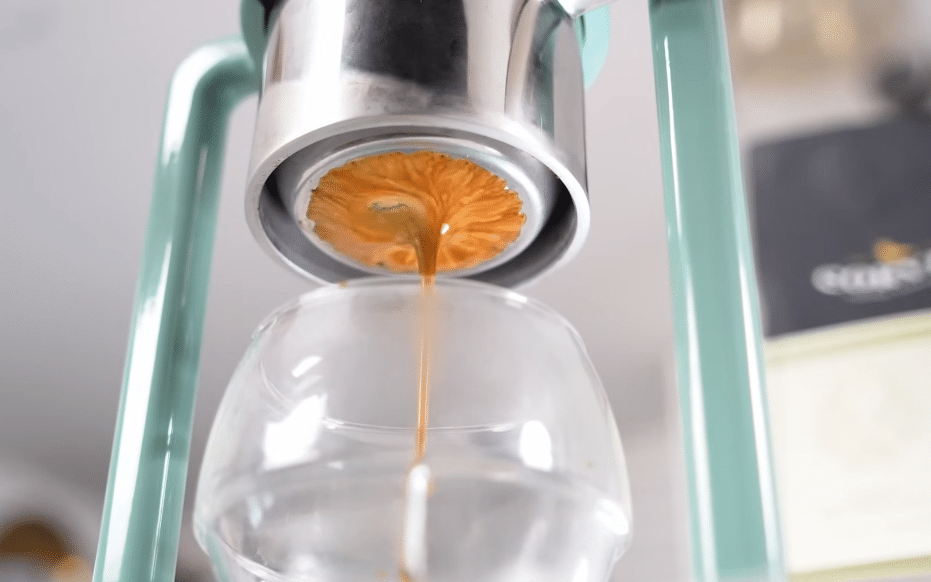
Almost confrontational simplicity characterizes the design logic. No boiler, no pump, and no electronics of any kind are present. After grinding your coffee, you tamp it into the 58mm stainless steel basket (the same size used in professional machines), pour hot water straight onto the puck from a kettle, and then use your hands to press down on the two lever arms. Espresso is created by manually applying pressure that pushes water through the coffee.
Water from a rolling boil cools to about 95 degrees Celsius as soon as it reaches the basket, which is nearly exactly the temperature you want for extraction. That has an almost subdued sense of satisfaction because physics is already taking care of the temperature control system.
For the compulsive type, the Barista model’s pressure gauge is where things get interesting. You are seeing actual extraction pressure rather than pump output because it is reading from inside the basket. Cafelat suggests extracting between 6 and 7 bar, which is the typical range for traditional lever machines.
According to Pratt, the 9 bar figure should be ignored because it refers to the pump output pressure on older machines rather than the actual pressure that the coffee is subjected to. It seems like a lot of home espresso culture has been built around that misinterpreted number for years, and the robot subtly fixes it without drawing attention to itself.
The robot can produce a shot that is genuinely difficult to discern from that of machines that cost ten times as much. Although that assertion sounds like marketing, reviews from reputable coffee magazines and home barista communities consistently reach the same conclusion.
According to Cafelat, the basket quality is outstanding because it is machined by the same company that makes baskets for the world’s top commercial equipment. Included is the bottomless portafilter option, which is usually found in professional setups. That’s a big deal for a machine that costs well under $1,000 and has no electronics.
However, there is a learning curve. The Robot literally puts everything in your hands, in contrast to capsule machines or even the majority of semi-automatics. Feel and practice control of pre-infusion timing, pour rate, and pressure consistency. That’s the whole appeal for some people. Others may eventually find it exhausting. The Robot appears to profit from both currents, though it’s still unclear if the expanding market for manual espresso machines is a true cultural shift toward craft and process or just a reaction against the sterile automation of pod culture.
It weighs 2.8 kg, is small enough to fit in a tiny kitchen, doesn’t make noise, doesn’t need to be descaled, and doesn’t include any plastic. That final point is not as relevant today as it may have been when the machine was first introduced. There’s a sense that Pratt stumbled into something timely without necessarily planning for it as the home espresso market moves toward the Robot—that is, toward fewer parts, less waste, and more involvement.
People are still divided by the look. In a retro-industrial sense, some people find it endearing, even lovely. For others, it seems a little absurd. However, it’s difficult to ignore the fact that almost everyone who uses one ends up keeping it.
FAQs
1. Does the Cafelat Robot require electricity or a boiler to make espresso?
No — it runs entirely on manual lever pressure and hot water from a kettle.
2. What pressure does the Cafelat Robot extract espresso at?
It extracts optimally between 6 and 7 bar, not the commonly cited 9.
3. Is the Cafelat Robot difficult to learn for beginners?
Yes — pressure, timing, and technique are all controlled entirely by hand.
4. What materials is the Cafelat Robot made from?
Aluminium body, stainless steel parts, and FDA-approved silicone — completely plastic-free.
5. Who designed the Cafelat Robot and when was it launched?
Paul Pratt of Hong Kong launched it via Kickstarter in spring 2018.
