
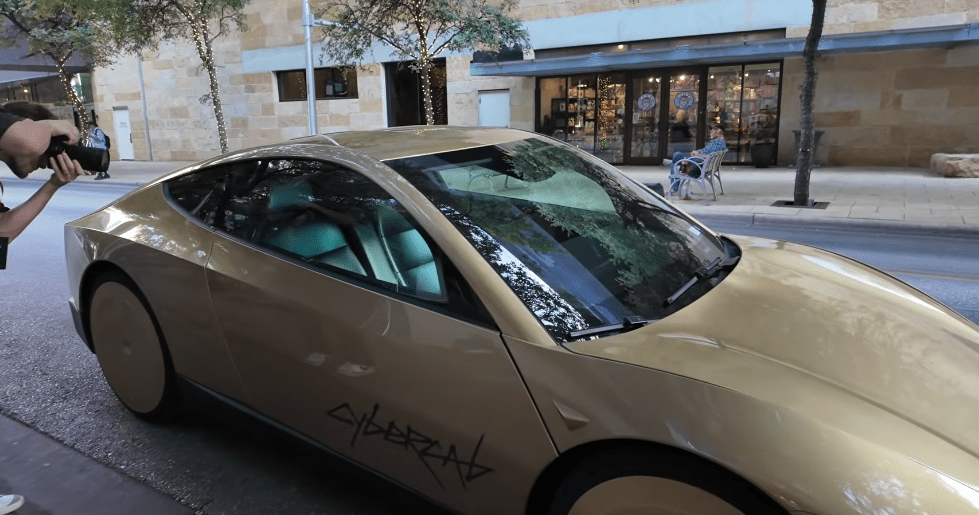
Watching a matte-gold car with butterfly doors drive through downtown Austin without a single person inside has a subtle surreal quality. No hand on the wheel, no driver looking in the rearview mirror. Just a car navigating traffic as though it had a purpose and didn’t need to explain itself. On September 3, 2026, Tesla formally introduced its Cybercab robotaxi for public commercial use. As is frequently the case with Tesla’s larger bets, Austin arrived first.
The Cybercab is completely electric, has two seats, and lacks all traditional control surfaces. Not a steering wheel. The brake pedal is absent. Not an accelerator. Not even mirrors. It was created in this manner from the beginning, which, depending on who you ask, is either visionary engineering or an extremely costly regulatory risk. It’s democratizing clean transportation, according to Tesla. It turns out that regulators have some inquiries.
The National Highway Traffic Safety Administration launched a formal investigation into Tesla’s certification of the vehicle’s compliance with federal motor vehicle safety standards less than a day after the launch event. The main problem isn’t necessarily that the Cybertruck is risky; rather, it’s that the standards were created under the assumption that a human driver would be on duty at all times. According to Tesla, a car that has no manual controls at all is exempt from some regulations. It seems reasonable that NHTSA would like to see the evidence and logic supporting that conclusion. Tesla might be correct. This could also become extremely complex very quickly.
The up-close appearance of the Cybercab is something that is easily missed in all the regulatory clamor. The interior is deliberately simple, almost to the point of being striking. The cabin is dominated by a large touchscreen that provides entertainment options while the car takes care of the rest. According to riders who have taken early public transportation, the experience is comfortable but a little confusing, similar to how the first escalator likely felt to someone used to stairs. The gold exterior catches light in a way that makes the car impossible to ignore on a city street, and the butterfly doors open with a dramatic flourish that looks great in photos.
Tesla has made an effort to present the Cybercab as more than just a tech product—rather, it is an accessibility milestone. In order to give blind and visually impaired riders a firsthand look at the vehicle, the company brought units to the annual convention of the National Federation of the Blind in Austin. Wheelchair-height seating, space for service animals, and Braille lettering on the physical controls aren’t last-minute additions. They seem to have been included from the beginning. Observing this development gives the impression that Tesla recognized early on that convenience for those who are already able to drive is not the strongest case for an autonomous vehicle. For those who cannot, it is freedom.
However, it’s important to maintain perspective. There were just 45 Cybercabs registered in Texas as of launch week. The service is available from 6 AM to 10 PM. The majority of the larger robotaxi fleet still uses Model Y SUVs, many of which in some states still need an onboard human supervisor. Waymo, Tesla’s most reliable rival in this market, has a solid safety record and currently operates in 11 cities. Tesla has previously had to close the gap between a launch event and a large-scale, operational transportation network, and it hasn’t always been easy.
It’s difficult to ignore the fact that Tesla is in a familiar position due to the NHTSA inquiry’s timing, which came just hours after the company’s commercial launch: acting quickly and then handling the institutional reaction after the fact. The question of whether that was daring or reckless is usually only addressed in retrospect. Currently, forty-five gold cars are traveling through Austin, transporting people who, even if they wanted to, would not be able to take the wheel. That could be the start of something truly novel, or it could be a highly visible test with significant consequences—probably both.
FAQs
1. Does the Tesla Cybercab have a steering wheel or pedals?
No — it was purpose-built with zero manual controls of any kind.
2. Where did the Cybercab first launch commercially?
Austin, Texas, on September 3, 2026.
3. Why is NHTSA investigating the Cybercab?
Federal safety standards assume a human driver, which the Cybercab lacks entirely.
4. What accessibility features does the Cybercab include?
Braille controls, wheelchair-height seating, service animal space, and 29-language app support.
5. How does Tesla’s Cybercab fleet compare to Waymo’s?
Waymo operates across 11 cities; Tesla had just 45 Cybercabs registered at launch.
