
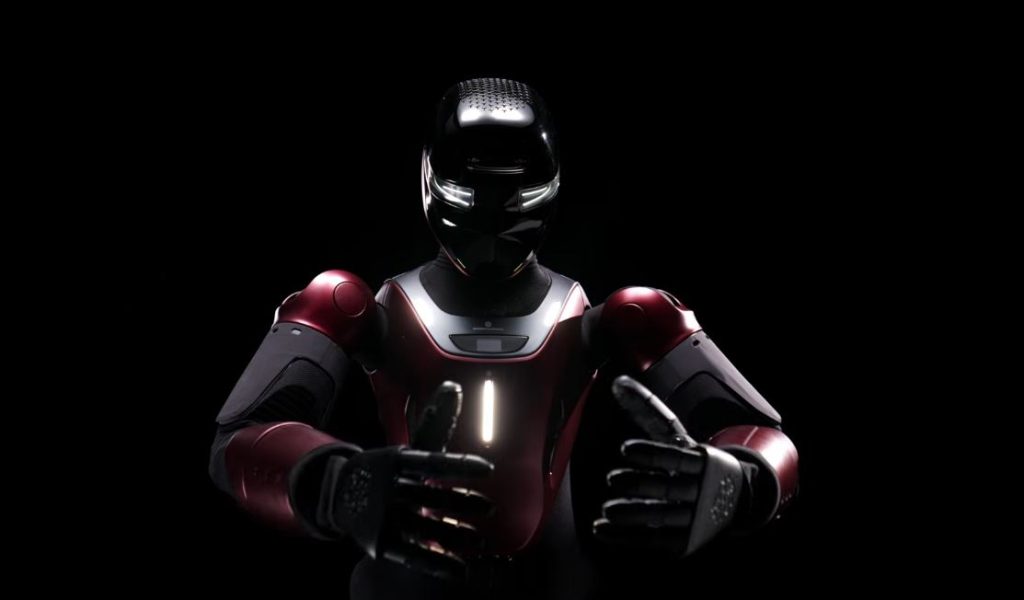
The city of Genoa is tilted toward the sea. The shipyards stretch along the western shore, the streets climb in winding switchbacks, and most evenings the ferries headed for Sardinia slide out of the harbor. Most people wouldn’t search there for the next big humanoid robot. However, Generative Bionics has been building one for the better part of a year just a short drive from those docks, and it finally showed Gene in July.01 Walking, reaching, and feeling in a way that is difficult to articulate without coming across as sentimental.
The skin is the most important detail. Because Gene.01’s body is covered in dispersed sensors that detect temperature, pressure, touch, and nearby movement, it can detect when a hand touches its forearm before a camera can detect it. That seems like a minor issue. It isn’t. Even though their vision systems are meant to prevent contact, the majority of humanoids still view it as an accident that should be avoided. Contact is treated as information by Gene.01, and it seems that this change is more what the company wants people to notice than any walking demonstration.
The other factor is speed. Late in 2025, Generative Bionics emerged from stealth with about €70 million and a history dating back 20 years to the Italian Institute of Technology, which produced the iCub and later the ergoCub. The idea presented at CES had developed into a functional machine six months later. Investors appear to think that the team’s discipline is demonstrated by their speed. The question factory managers will eventually ask, usually while standing next to a broken prototype at the end of a long shift, is whether or not it proves anything about durability.
Let’s talk about that term, “open-source skin.” It’s somewhat deceptive, but it’s catchy. The robot model, a digital twin that anyone can download and use in simulation, has been made available by the company. Packages for PyPI, Conda, and the ROS ecosystem are promised. For the time being at least, the tactile hardware itself remains proprietary. The gesture is important, though.
Grasping algorithms can now be tested against Gene.01’s exact body by a graduate student in Lyon or Lahore without having to purchase one. Much of contemporary computer vision was quietly developed using open-source tools, and it’s possible that the same pattern could recur here, slowly and almost imperceptibly.
However, the early sign-ups are what give the project a sense of groundedness. A four-year partnership aimed at humanoid welders was agreed upon in February by Fincantieri, the shipbuilder whose yards stretch along the Italian coast. The Turin company Italdesign, which is best known for creating automobiles, joined the industrialization effort. Additionally, Eni signed an exploratory agreement on October 1 that covers robot footwear materials as well as inspection work. shoes. It’s a peculiarly specific detail that, in some way, gives the entire scene more realism than any glossy render could.
It’s difficult not to draw comparisons between Gene.01 and the more vocal players as you watch this play out. The arrival of Tesla’s Optimus is a spectacle. European engineers shudder at the prices at which Chinese manufacturers ship their products. In the same way that some businesses receive awards, Figure gathers funding rounds.
By relying on peer-reviewed ergonomics and the notion that body and intelligence should be designed together rather than bolted together later, generative bionics has adopted a different, more patient approach. It is referred to by the company as “physics-native AI.” When the branding is removed, the concept is rather archaic: a robot that moves well because its shape facilitates easy movement.
There are justifications for being cautious. A memorandum of understanding is not an order, and a functional platform is not a product. How it survives months of sparks, grease, and unintentional knocks in a shipyard, as well as the cost of replacing a damaged patch, are some of the awkward questions raised by smart skin. Humanoids have long been perceived as fragile on the ground and finished on stage. For years, Honda’s ASIMO captivated the world without ever landing a legitimate job.
Nevertheless, Gene.01 seems to have a distinct tone. Replacing the welder in Fincantieri’s yard doesn’t seem promising. Standing next to him, feeling his elbow before it gets too close, and pulling back is promising. That’s a more modest and possibly more astute pitch than most in this field. While attention is still focused on Shenzhen and Austin, Europe’s humanoid industry has received little attention. However, buyers are signing deals here, and this robot was designed with them in mind.
Gene.01’s endurance may be more important than its skin in determining whether it becomes a standard in factories or a well-documented footnote. For the time being, even skeptics will lean a little closer to a robot that can sense heat and hesitate when touched by a human.
FAQs
1. What is Gene.01?
A humanoid robot from Italy’s Generative Bionics, built for safe human collaboration.
2. What makes Gene.01’s skin special?
It senses touch, pressure, nearby movement, and temperature across its body.
3. Is the robot’s skin actually open-source?
No, only the digital twin robot model is open; the tactile hardware stays proprietary.
4. How long did Gene.01 take to build?
Roughly six months, from CES 2026 concept to working robot.
5. Which companies have partnered with Generative Bionics?
Fincantieri, Italdesign, and Eni through an exploratory agreement.
