

On August 22, 2026, Zheng Jie stepped out onto Beijing’s National Speed Skating Oval in the still-bright afternoon light. The location was a strange choice because it was designed for winter speed skating rather than tennis. Glistening, expansive, built for cold air and ice. However, nothing about what was going to occur could be neatly categorized.
A humanoid robot created by Beijing-based robotics company Galbot stood across the net. It had no coach in its corner. No warm-up. Just sensors, algorithms, and a racket held by a hand that would never tremble—no nerves at all.
Depending on who you ask, what transpired during the next stretch of play has been described as either a technical demonstration, a spectacle, or something that should cause professional athletes some minor discomfort. Zheng Jie, a former WTA player in the top 30, a quarterfinalist at Wimbledon, and someone who has competed at the top levels of a fiercely competitive sport for twenty years, was forced to truly work for her opportunities.
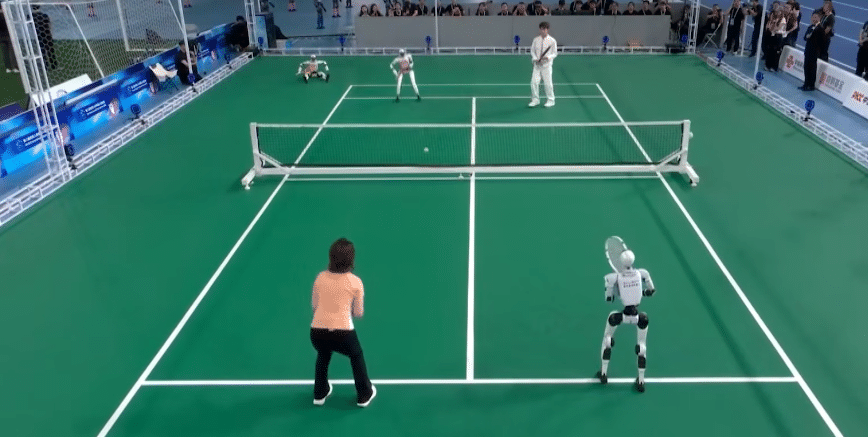
Running on an AI system called AstraBrain, the robot tracked her spins, read her slices, and fired serves at speeds exceeding 100 km/h. At one particularly memorable moment, it fell backward during a high-intensity rally, hit the ground, and then got back up to continue playing. That type of composure has no appropriate term, in part because it isn’t composure at all. It takes something to overcome to maintain composure. There was nothing for the robot to defeat.
The match took place at the start of the Second World Humanoid Robot Sports Games, which sounds a little ridiculous until you watch the video and realize you’ve been staring at your screen for forty minutes nonstop.
These competitions, which include humanoid robots racing on tracks, clearing bar heights that have already surpassed official world records set by human athletes, and now, apparently, competing in racket sports against actual champions, are being held in China as a hybrid of an engineering showcase and a sporting festival. Zheng Jie wasn’t the only one in that peculiar situation. At the same event, Olympic table tennis champion Ding Ning faced a robot from a research team at the University of Hong Kong.
Because the term “autonomous” is used so loosely in this context, it is worthwhile to consider what it truly means. There was no script that the Galbot robot adhered to. A technician seated off-court did not operate it remotely. It made decisions about positioning and shot selection without human input by using real-time perception, which involves cameras and sensors tracking the ball’s trajectory, speed, and spin.
A closed “perception-decision-execution” loop, which sounds clinical until you consider that a tennis ball can travel at speeds of hundreds of kilometers per hour, bounce differently on every surface, and carry spin that changes as soon as it leaves the opponent’s racket, was the result of the work done in partnership with Tsinghua University. On a court it had never played on before, the robot handled all of that in real time.
Skepticism is unavoidable in this situation. It was an exhibition match. Zheng Jie wasn’t competing under pressure to win a tournament point. Unlike typical Wimbledon equipment, the court was outfitted with external motion-capture cameras that tracked ball coordinates at millisecond intervals. It would be overselling the situation to describe this as a clear victory over a skilled human athlete. However, ignoring it as a gimmick would also overlook something truly important.
Whether the robot prevailed is not the more intriguing question. It had to do that to stay up. As you watch the video, you see the machine shifting its weight mid-stride, bending at the knees to reach a low ball, measuring the angle, and choosing a lob. These are not responses that have been preprogrammed. They are responses.
This distinction is important because reaction, or real-time physical judgment, is what distinguishes an expensive novelty from a useful robot. Because racket sports require split-second integration of perception, decision, and movement simultaneously, researchers in this field have long claimed that they represent a meaningful stress test for embodied AI, more difficult than dancing or sprinting.
How quickly any of this translates into the settings where it would truly matter—factory floors, warehouses, and kitchens—remains to be seen. There is still a big difference between the chaotic unpredictability of real life and a spotless tennis court with well-calibrated lighting.
Even though no one can quite agree on what it was, something crossed a threshold that afternoon in Beijing. After playing the most bizarre match of her career, Zheng Jie left the court. With its racket still in hand, the robot just stood there, waiting for whatever would happen next.
FAQs
Q1. Where and when did the Zheng Jie robot match take place?
At Beijing’s National Speed Skating Oval on August 22, 2026.
Q2. Who built the robot that played against Zheng Jie?
Galbot, a Beijing firm, developed it alongside Tsinghua University.
Q3. Was the robot being controlled by a human during the match?
No — it made all decisions autonomously using its AstraBrain AI system.
Q4. What happened when the robot fell during the rally?
It got back up immediately and continued playing without interruption.
Q5. Does this mean robots can now beat professional tennis players?
Not yet — the match was an exhibition with special court-side camera support.
